
Dentists commonly describe the following problems:
Not enough space for all teeth to sit in a regular line.
Gaps between teeth.
The upper front teeth overlap the lower teeth more than usual.
The lower front teeth sit in front of the upper teeth.
Some upper teeth sit inside the lower teeth when biting down.
The front or side teeth do not meet when the mouth is closed.
Several appliances are used for teeth alignment treatment. Suitability depends on the person’s teeth, bite and oral hygiene, and the choice is made after examination and discussion with the treating dentist.
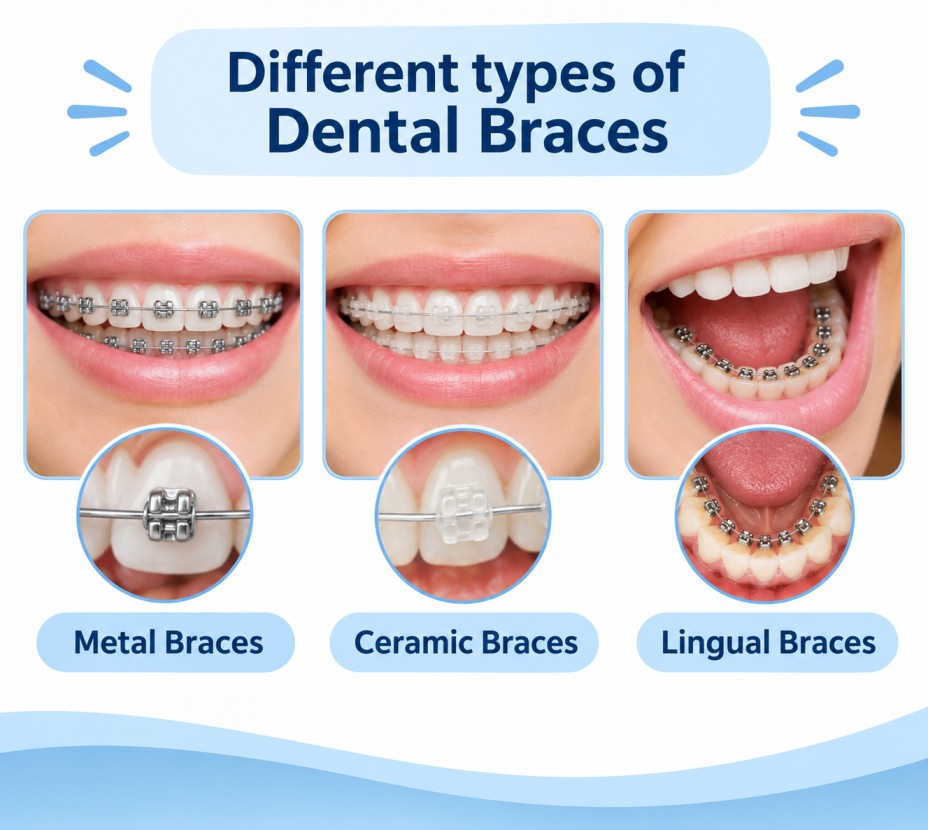
The steps below follow general orthodontic practice, which also applies to dental braces treatment in Ghaziabad. They can differ between patients.
Most people feel some pressure or mild soreness for a few days after fitting and after adjustments. Soft foods and pain relief advised by the dentist or pharmacist are often used. Severe or persistent pain should be checked.
There is no single age. Children are often assessed around 7 to 9 years, many begin treatment in their early teens, and adults can also be treated if their teeth and gums are healthy. A dental examination helps decide the timing.
Treatment commonly lasts about one to three years, though simple cases may be shorter and complex cases longer. Duration depends on the alignment problem, the appliance and how well instructions are followed.
No. Fixed braces are bonded to the teeth, whereas clear aligners are removable trays. A dentist decides which approach is clinically appropriate after examination.
Children should use age-appropriate fluoride toothpaste in the recommended quantity. Parents should supervise brushing, especially in younger children, to ensure proper cleaning.
Sometimes permanent teeth begin erupting behind milk teeth, particularly the lower front teeth. This is commonly called shark teeth. A dental examination can help determine whether monitoring or treatment is needed.